




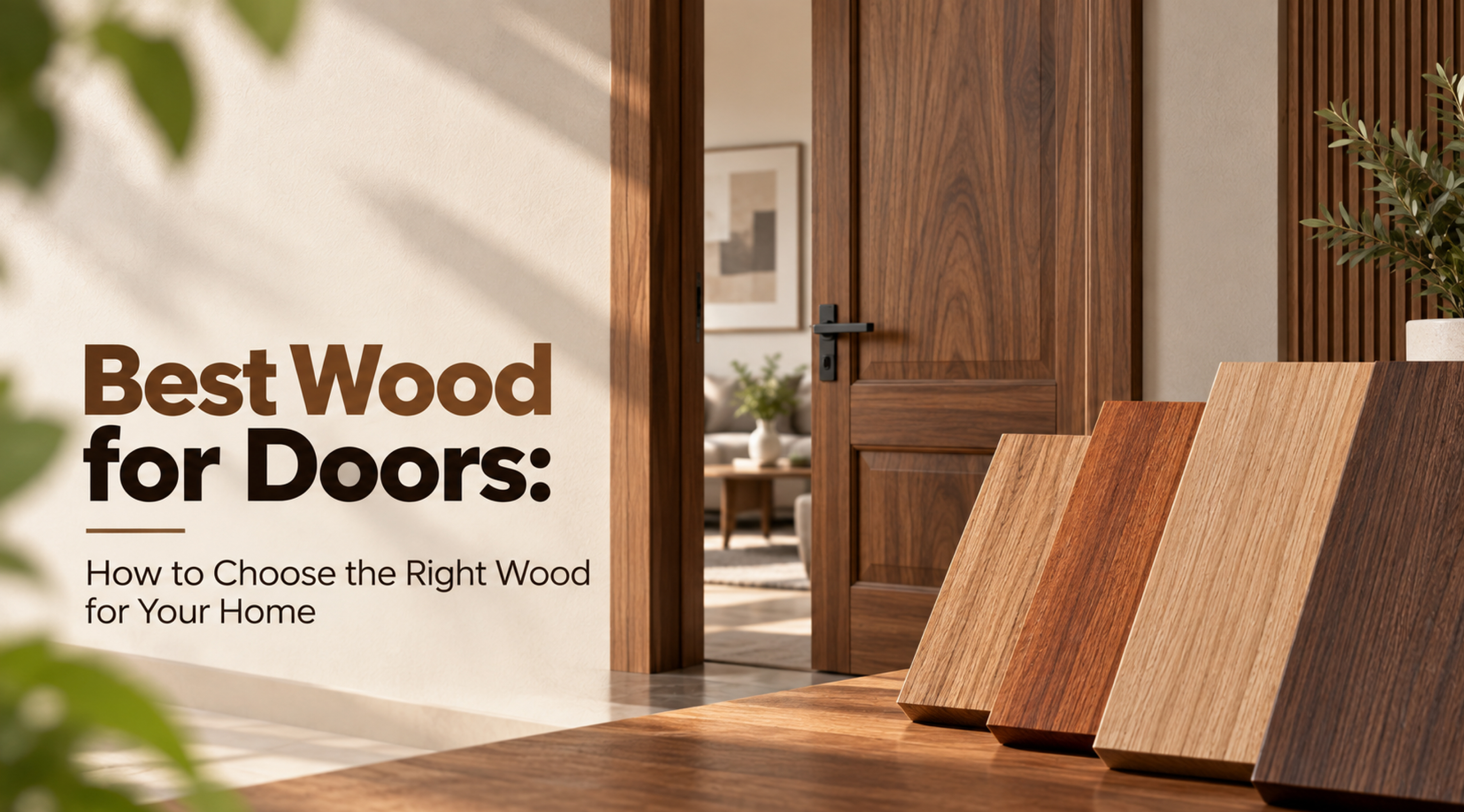
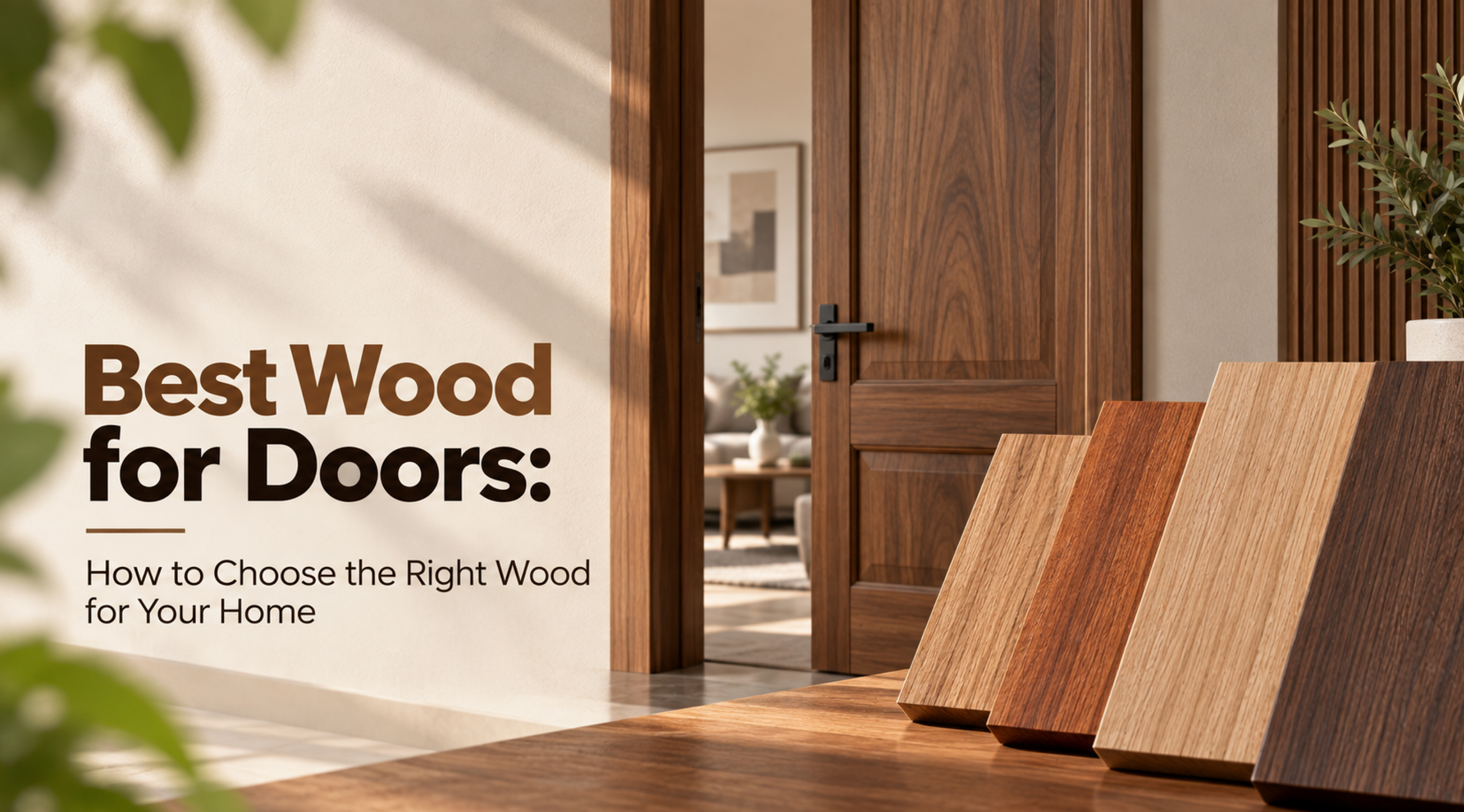
Best Wood for Doors
Choosing a door is usually about more than just finding a design you like.
You also need to decide what the door is made from. And when you start comparing teak, sal, mahogany, sheesham, oak and other options, one question naturally comes up:
What is the best wood for doors?
The honest answer is that there is no single wood that is perfect for every door.
The best choice depends on where the door will be installed, how much moisture and weather it will face, how much maintenance you are comfortable with and how much you want to spend.
For example, the wood that makes sense for a home's main entrance may not be necessary for a bedroom door. Similarly, a door in a humid coastal city has different requirements from one installed inside a dry apartment.
Let's look at the most popular options and how to choose between them.
What Makes a Wood Good for Doors?
Before comparing individual wood species, it helps to understand what actually matters.
A good door material should provide an appropriate combination of:
- Strength
- Durability
- Dimensional stability
- Resistance to moisture
- Resistance to termites and insects
- Good appearance
- Ease of finishing
- Reasonable maintenance
- Suitability for the location
The right balance is more important than choosing a wood simply because it is considered premium.
For example, teak is known for durability and natural resistance to moisture, while pine is easier to work with and generally more economical. Sal is valued for strength, while mahogany is often chosen for its appearance and stability.
1. Teak Wood: A Premium Choice for Doors
When people ask about the best wood for doors, teak is usually one of the first names mentioned.
There is a good reason for that.
Teak is a dense hardwood with natural oils that help it resist moisture, insects and decay. It also has an attractive grain and takes finishes well.
These properties make teak particularly suitable for main doors and other openings where durability and appearance are both important.
Why choose teak?
- Excellent durability
- Good natural moisture resistance
- Attractive grain
- Good dimensional stability
- Suitable for premium doors
- Works well with polished finishes
Imagine a large main entrance with a carved wooden door.
You want the material to handle frequent use while also looking impressive when guests arrive. Teak can make sense in that situation because it combines structural performance with a premium natural appearance.
The drawback
Teak is usually more expensive than many other wood options.
So you may not need teak for every door in the house.
Using it for the main entrance and choosing a more economical material for less demanding interior doors can be a more sensible way to manage the overall budget.
2. Sal Wood: Strong and Durable
Sal is another popular hardwood in India, particularly when strength is a major priority.
Its dense structure gives it good structural strength, making it suitable for heavy-duty applications and door frames.
Compared with teak, sal can be a more cost-conscious option while still providing strong performance when it is properly seasoned and treated.
This is important because the quality of timber matters enormously.
A properly seasoned and treated piece of sal can perform much better than poorly prepared timber of a more expensive species.
When is sal a good choice?
Sal can make sense when you need:
- High structural strength
- A durable hardwood
- A more economical alternative to premium teak
- A frame or door for demanding applications
For example, if you are installing several substantial doors in a large home, sal can provide a practical balance between strength and cost.
3. Mahogany: Durability With a Rich Appearance
Mahogany is popular among homeowners who want durability without sacrificing appearance.
Its reddish-brown colour and relatively consistent grain give it a distinctive look.
It is often considered for both interior and exterior applications, depending on the species, quality, treatment and local conditions.
Mahogany can be particularly attractive for homeowners who want a traditional, elegant entrance without using a heavily carved design.
A simple mahogany door with a clear or semi-transparent finish can allow the natural colour and grain to become the main visual feature.
Why consider mahogany?
- Rich natural colour
- Attractive grain
- Good durability
- Suitable for decorative doors
- Can complement traditional and contemporary interiors
As with any timber, the actual performance depends on sourcing, seasoning, treatment, construction and finishing.
4. Sheesham Wood: Strong With Distinctive Grain
Sheesham, also known as Indian rosewood, is another well-known choice for wooden furniture and doors.
Its biggest visual advantage is its distinctive grain.
If you prefer a door that looks naturally patterned rather than completely uniform, sheesham can be an interesting option.
It is also a relatively hard and durable wood.
A sheesham door can work particularly well in homes where the natural character of timber is meant to remain visible rather than being hidden under an opaque paint finish.
When should you consider sheesham?
It can be suitable when you want:
- A strong hardwood
- Distinctive natural grain
- A traditional appearance
- A balance between aesthetics and durability
Proper sealing and finishing are particularly important where the door is exposed to moisture.
5. Oak Wood: Strong and Versatile
Oak is widely recognised for its strength, durability and distinctive grain.
Both red oak and white oak are commonly discussed in door applications, although their properties differ.
Oak can suit modern as well as traditional interiors because its grain provides visual character without requiring elaborate carving.
It can be a good choice when you want a substantial wooden door with a clean, timeless appearance.
For example, an oak door with a simple vertical-panel design can look equally appropriate in a contemporary home or a more traditional interior.
Best Wood for Main Doors
The main door has different requirements from an interior bedroom door.
It is exposed to more frequent use and, depending on the design, may face sunlight, humidity, rain and temperature changes.
For this reason, premium hardwoods such as teak are often considered for main entrances. Sal and mahogany can also be suitable depending on the project's requirements and the quality of the timber.
For a main door, look beyond the wood species and check:
- Timber quality
- Seasoning
- Moisture content
- Treatment
- Door thickness
- Frame construction
- Exterior finish
- Hardware
- Installation quality
A premium species cannot compensate for poor manufacturing or installation.
Best Wood for Interior Doors
Interior doors generally have a more controlled environment.
A bedroom, study or internal passage door is usually not exposed to direct rain or extreme outdoor conditions.
This gives you more flexibility.
You can choose a wood based on appearance, budget, weight and the overall interior design rather than automatically selecting the most weather-resistant species.
For example, spending significantly more on teak for every bedroom door may not be necessary if a suitable alternative can provide the required performance at a lower cost.
This is where proper planning can make a substantial difference to the total cost of a home project.
What About Humid and Coastal Areas?
Climate should be one of the first things you consider when choosing wood.
A door installed in a humid or coastal location can experience more moisture than one in a dry inland environment.
In such conditions, moisture resistance and dimensional stability become especially important.
Teak is often preferred for demanding exterior applications because of its natural oil content and resistance to moisture.
But the wood alone is not the complete solution.
Good sealing, appropriate finishing, correct installation and protection from standing water are also essential.
Does Seasoning Matter More Than the Type of Wood?
It can matter a lot.
One of the common mistakes buyers make is asking only, "Which wood is best?"
A better question is:
"Is the wood properly seasoned and prepared for my application?"
Wood naturally contains moisture. If timber is not properly seasoned before being manufactured into a door or frame, it can change dimensions as it dries.
That can contribute to issues such as warping, cracking or gaps.
This is why timber quality, moisture control and manufacturing processes should be considered alongside species.
A properly prepared, well-manufactured frame can outperform a poorly prepared frame made from a supposedly premium wood.
How Much Maintenance Does a Wooden Door Need?
Maintenance depends on the wood, finish, location and exposure.
An exterior wooden door may need more attention than an interior bedroom door because it faces sunlight, rain and changing humidity.
Regularly check for:
- Surface cracks
- Peeling finish
- Moisture damage
- Insect activity
- Loose hardware
- Gaps around the frame
If you notice a small finishing problem early, it is generally easier to address than waiting until moisture reaches deeper into the timber.
How to Choose the Best Wood for Your Door
Instead of asking which wood is universally "best," use this simple decision process.
Step 1: Identify the location
Is it a main entrance, bedroom, bathroom, office or utility area?
Step 2: Consider the climate
Is the property dry, humid, coastal or exposed to heavy monsoon conditions?
Step 3: Decide your priority
Do you care most about:
- Maximum durability?
- Premium appearance?
- Budget?
- Low maintenance?
- Natural grain?
Step 4: Compare the timber
Look at teak, sal, mahogany, sheesham, oak or other suitable options based on those priorities.
Step 5: Check the actual product quality
Ask about seasoning, treatment, dimensions, manufacturing accuracy and warranty.
This final step is often overlooked.
A teak door may be the better investment for a premium main entrance, while a different hardwood may make more financial sense for multiple interior doors.
Why Choose Bhutan Tuff for Wooden Door Frames?
Bhutan Tuff focuses on wooden door frames designed to combine structural performance with the natural appearance of wood.
Its wooden door-frame range is positioned for residential, commercial and institutional applications and includes quality-focused manufacturing features such as dual-side calibration, glue-line treatment, 360-degree sanding, self-balancing technology and high load-bearing capability.
The company also highlights features such as termite and fungi protection, low formaldehyde emission certification and ISI certification across its product information.
This matters because choosing the right wood is only one part of buying a good door frame.
The manufacturing process, treatment, calibration, finishing and installation all influence how the finished frame performs.
If you are building a new home or renovating an existing one, Bhutan Tuff can help you evaluate the appropriate wooden door-frame solution based on the application rather than simply choosing a wood species by name.
Frequently Asked Questions
Which is the best wood for doors?
There is no single best wood for every application. Teak is a strong premium choice for main and exterior doors, while sal, mahogany, sheesham and oak can be suitable depending on the location, climate, budget and desired appearance.
Which wood is best for a main door?
Teak is commonly considered one of the premium choices for main doors because of its durability, natural moisture resistance and appearance. Sal and mahogany can also be suitable depending on the project requirements.
Is teak better than sal wood?
Not necessarily for every project. Teak generally offers premium appearance and natural moisture resistance, while sal is known for strength and can provide better value where budget and structural performance are priorities.
Which wood is best for interior doors?
For interior doors, you have more flexibility because they are usually exposed to fewer weather conditions. The choice can depend on budget, design, weight, durability and the finish you want.
Is mahogany good for doors?
Mahogany can be a good choice when you want a durable door with a rich reddish-brown appearance. Its suitability depends on the specific wood, quality, treatment and application.
Does wooden door quality depend only on the wood type?
No. Seasoning, moisture content, timber grade, manufacturing accuracy, treatment, finishing and installation can all affect the final performance.
Final Thoughts
So, what is the best wood for doors?
The answer depends on the door you are building.
For a premium main entrance, teak can be an excellent choice. If strength and value are priorities, sal may be worth considering. Mahogany offers a rich appearance, sheesham brings distinctive natural grain, and oak provides strength and versatility.
But do not make the decision based on wood species alone.
Think about where the door will be installed, what climate it will face, how much maintenance you want to do and what your budget allows.
Most importantly, pay attention to the quality of the actual timber and manufacturing process.
A well-seasoned, properly treated and accurately manufactured door frame can make a bigger difference to long-term performance than simply choosing the most expensive wood available.
For homeowners, architects and contractors looking for reliable wooden door-frame solutions, Bhutan Tuff combines wood selection with controlled manufacturing and quality-focused construction to create frames designed for long-term use.
The best wood is ultimately the one that fits your project—not simply the one with the highest price tag.