




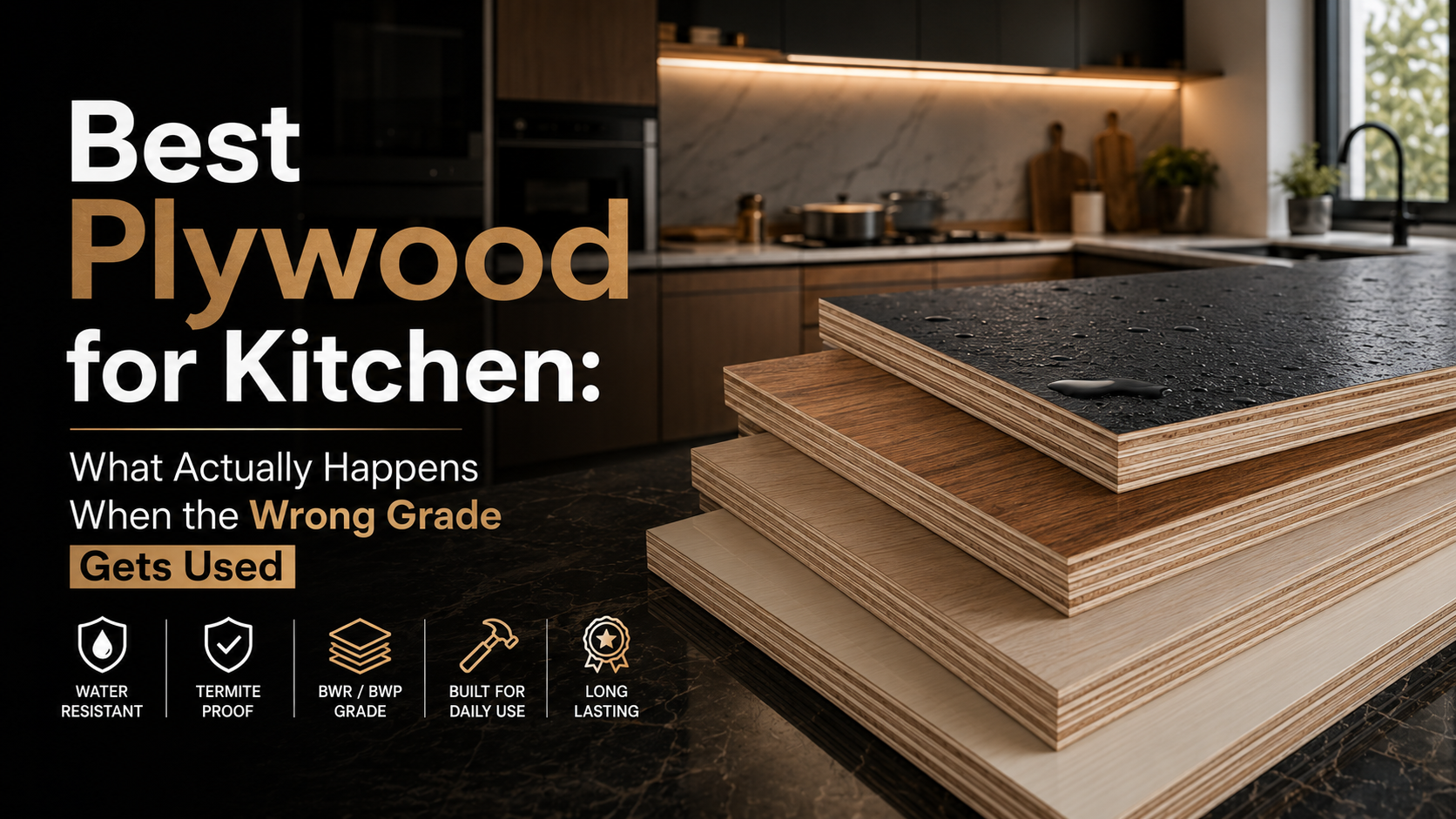
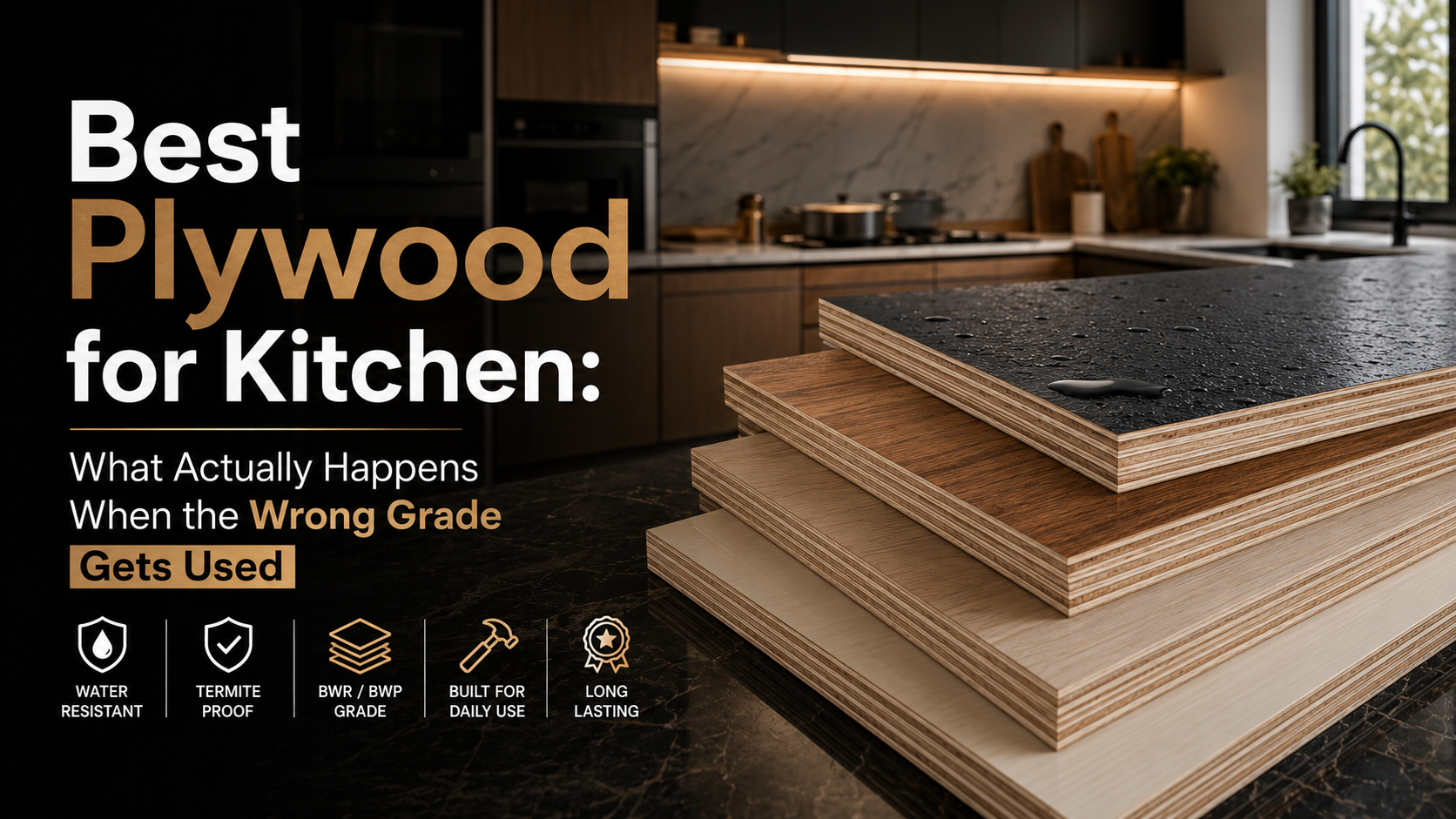
Best Plywood for Kitchen: What Actually Happens When the Wrong Grade Gets Used
Ask any plywood website which grade is Best plywood for kitchen, and you'll get the same answer: BWP or marine grade near the sink, BWR for the rest of the carcass. That's correct, and it's genuinely useful information. What's missing from almost every guide is what actually happens when the wrong grade ends up in your kitchen anyway and the uncomfortable reality that, in a lot of modular kitchen projects, it's not the homeowner who chose the wrong grade. It's what got installed instead of what was quoted.
We're Bhutan Tuff, a BIS-certified plywood manufacturer, and this is what we've seen go wrong in kitchens not just the grade chart, but the real sequence of failure, and how to make sure what's actually installed in your kitchen matches what you paid for.
What actually happens when the wrong grade goes into a kitchen
Swells in moisture is technically accurate but doesn't tell you much about the actual experience. Here's the real sequence, because knowing it helps you catch a problem early instead of discovering it at year three when replacement is the only option.
Months 1–6: Nothing looks wrong. MR-grade plywood installed under a sink or near a dishwasher performs fine at first, because moisture exposure is intermittent, not constant. This is exactly why the mistake goes unnoticed at handover — everything genuinely looks fine.
Months 6–18: Edges start to matter. Cut edges are where plywood is most vulnerable, and if they weren't properly sealed, this is where moisture starts working into the ply layers first — usually at the base of a sink cabinet or the corner nearest a dishwasher, long before the visible face of the cabinet shows any sign of trouble.
Year 2–3: Delamination becomes visible. Layers start separating at the edges, doors that used to close flush start sitting slightly off, and screw holes for hinges — which are opened and closed daily — begin to feel looser than they used to. This is usually the point homeowners first call it a "cheap cabinet" problem rather than a plywood grade problem, because the symptoms look like general wear rather than a material failure.
Year 3–5: Full replacement becomes the realistic option. Once delamination has progressed this far, resealing or patching doesn't hold for long, and the cabinet needs rebuilding — at a cost far higher than the difference between MR and BWP grade would have been at the start.
Knowing this timeline matters because the early signs — a slightly stiff door, a hinge that needs re-tightening sooner than expected — are worth investigating immediately, not dismissing as normal wear.
The problem nobody's guide mentions: what gets quoted isn't always what gets installed
Every kitchen plywood article assumes the buyer is the one choosing the grade. In reality, most modular kitchens are built by a contractor or kitchen company, and the plywood grade lives in a quote or contract line item that most homeowners never see installed in person. The gap between "BWP grade, as quoted" and what's actually behind the cabinet face is a real, well-documented source of complaints in India's modular kitchen industry — not because every contractor is dishonest, but because it's genuinely difficult for a homeowner to verify after the cabinets are assembled and finished.
This isn't a reason to distrust every contractor. It's a reason to build a simple verification step into the project instead of relying entirely on the quote.
A homeowner in Bangalore building a modular kitchen specifically asked their contractor to keep a labelled offcut from each plywood batch used on the project — the leftover pieces after cutting cabinet panels. It cost nothing and took no extra time, but it meant there was physical, checkable material matching the grade that was billed, rather than relying purely on trust after the cabinets were sealed shut.
A kitchen renovation in Chennai, in a coastal, high-humidity setting, specifically requested that the sink cabinet and dishwasher surround be built and photographed before the counter and backsplash went in — because once those are installed, the plywood behind them is essentially permanently hidden. A five-minute photo before final assembly is a small ask that removes any ambiguity later.
A quick, practical grade guide for different kitchen zones
Since the grade question is genuinely important, here's the short version, without the exhaustive spec-sheet most articles turn it into:
- Sink cabinet, dishwasher surround, any unit directly below a water source: BWP or 710 marine grade, no exceptions. This is the one place in the kitchen where cutting cost on grade creates the fastest, most expensive failure.
- General carcass and shutters away from direct water contact: BWR is a reasonable, cost-effective standard for most Indian kitchens, particularly inland or in drier climates.
- Coastal cities or consistently humid kitchens: Marine grade throughout the lower cabinet run is worth the extra cost, since ambient humidity alone — not just direct spills — becomes a factor.
- Overhead cabinets away from moisture: MR grade is usually acceptable here, since exposure is minimal and the cost saving is genuine without meaningful risk.
What to actually do to protect the investment
Get the grade specified in writing, by name and standard. "Waterproof plywood" is vague. "BWP grade, IS 710" is specific and checkable.
Ask to see or keep offcuts from each batch used. This costs nothing and gives you physical material to compare against the invoice if a question ever comes up.
Photograph vulnerable areas before they're sealed. Sink cabinets, dishwasher surrounds, and any area that becomes inaccessible after installation are worth thirty seconds of documentation.
Insist on sealed edges, especially around cutouts. A correctly graded sheet with unsealed cut edges around a sink hole can still fail early, because the edge is where moisture gets in first regardless of grade.
Buy from a manufacturer who can confirm the grade directly, not just a dealer relaying a claim. A traceable batch and a direct manufacturer relationship remove one layer of "trust me" from a decision that's expensive to get wrong.
What Bhutan Tuff offers for kitchen applications
Our 710 marine-grade plywood is manufactured to IS:710 standards with SBT technology and undiluted resin, making it borer and termite-resistant and genuinely suited to sink cabinets, dishwasher surrounds, and any kitchen zone with sustained moisture exposure — backed by up to a 15-year warranty and available across the thicknesses a kitchen actually needs, from 4mm to 19mm. As a direct manufacturer, we can confirm grade and batch details clearly, rather than leaving that confirmation to a middle party.
The short version
BWP or marine grade near water, BWR for the rest — that part of the kitchen plywood decision is well established and genuinely correct. What deserves equal attention is making sure what actually goes into the cabinets matches what was agreed, since the gap between a quote and an installation is where most expensive kitchen plywood failures actually start, not from buyers picking the wrong grade in the first place.
Building or renovating a kitchen? Get in touch with Bhutan Tuff for BIS-certified 710 marine and BWR plywood, with clear grade and batch confirmation for your project.
FAQs
What is the best plywood grade for kitchen cabinets in India? BWP (Boiling Water Proof) or 710 marine-grade plywood is best for sink cabinets and any area with direct water exposure. BWR grade is a reasonable, cost-effective choice for the rest of the kitchen carcass away from direct moisture.
How long does MR grade plywood last in a kitchen? MR grade can look fine initially even in a kitchen, since moisture exposure is often intermittent rather than constant. However, in areas near sinks or dishwashers, it typically shows delamination and swelling within 2–3 years, well before BWP or marine grade would in the same location.
How can I confirm my contractor actually used the plywood grade I paid for? Ask for labelled offcuts from each batch used, request photos of vulnerable areas like sink cabinets before they're sealed, and get the grade specified by name and IS standard in writing rather than a vague term like "waterproof plywood."
Do I need marine-grade plywood throughout the whole kitchen? Not necessarily. Marine or BWP grade matters most directly under sinks and around dishwashers. BWR grade is generally sufficient for the rest of the carcass, and MR grade can be acceptable for overhead cabinets away from moisture.
Why do cut edges matter so much in kitchen plywood? Cut edges expose the inner layers of the plywood directly to moisture. If edges around sink cutouts or cabinet joints aren't properly sealed, moisture can enter through the edge and cause delamination even in a correctly graded sheet.