




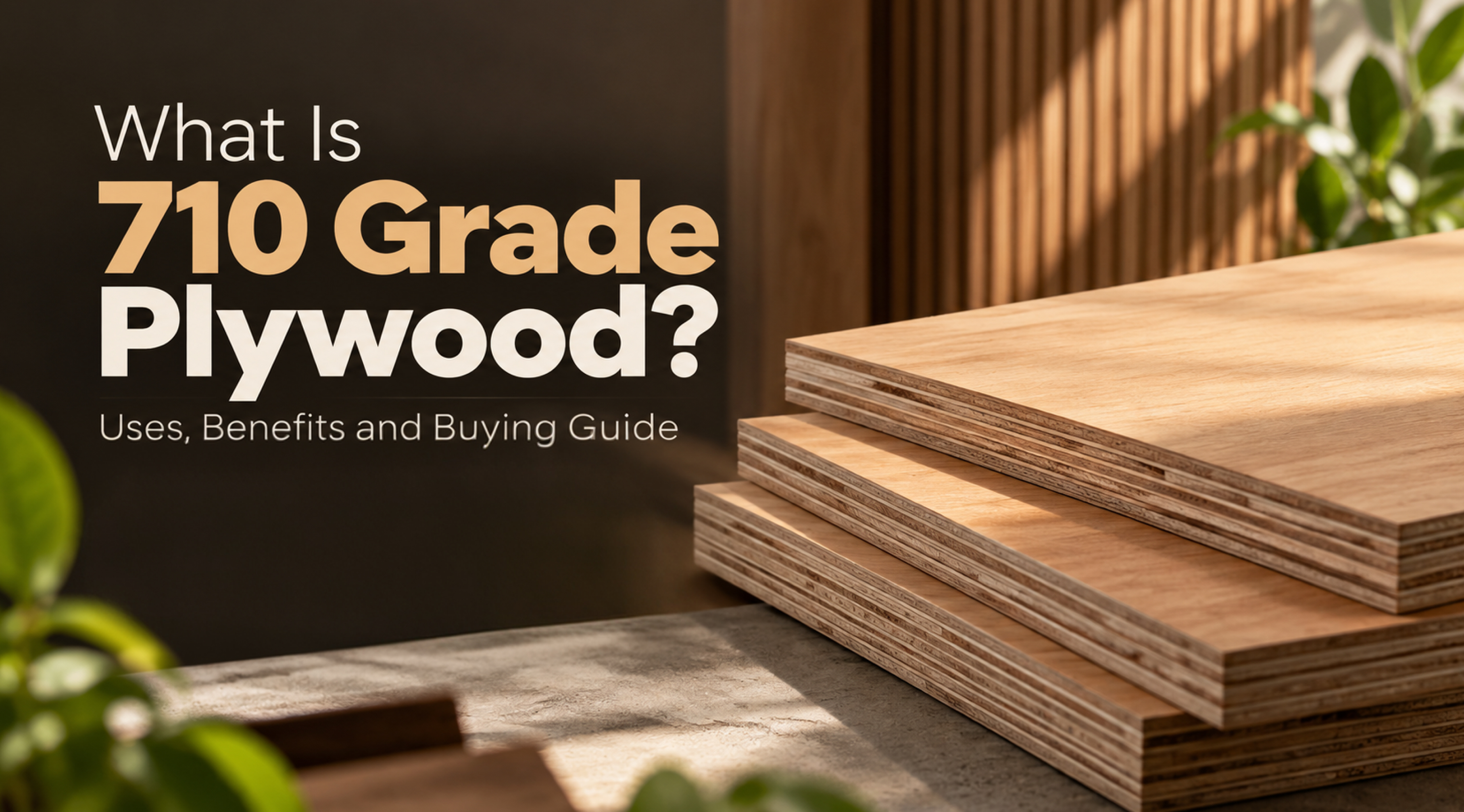
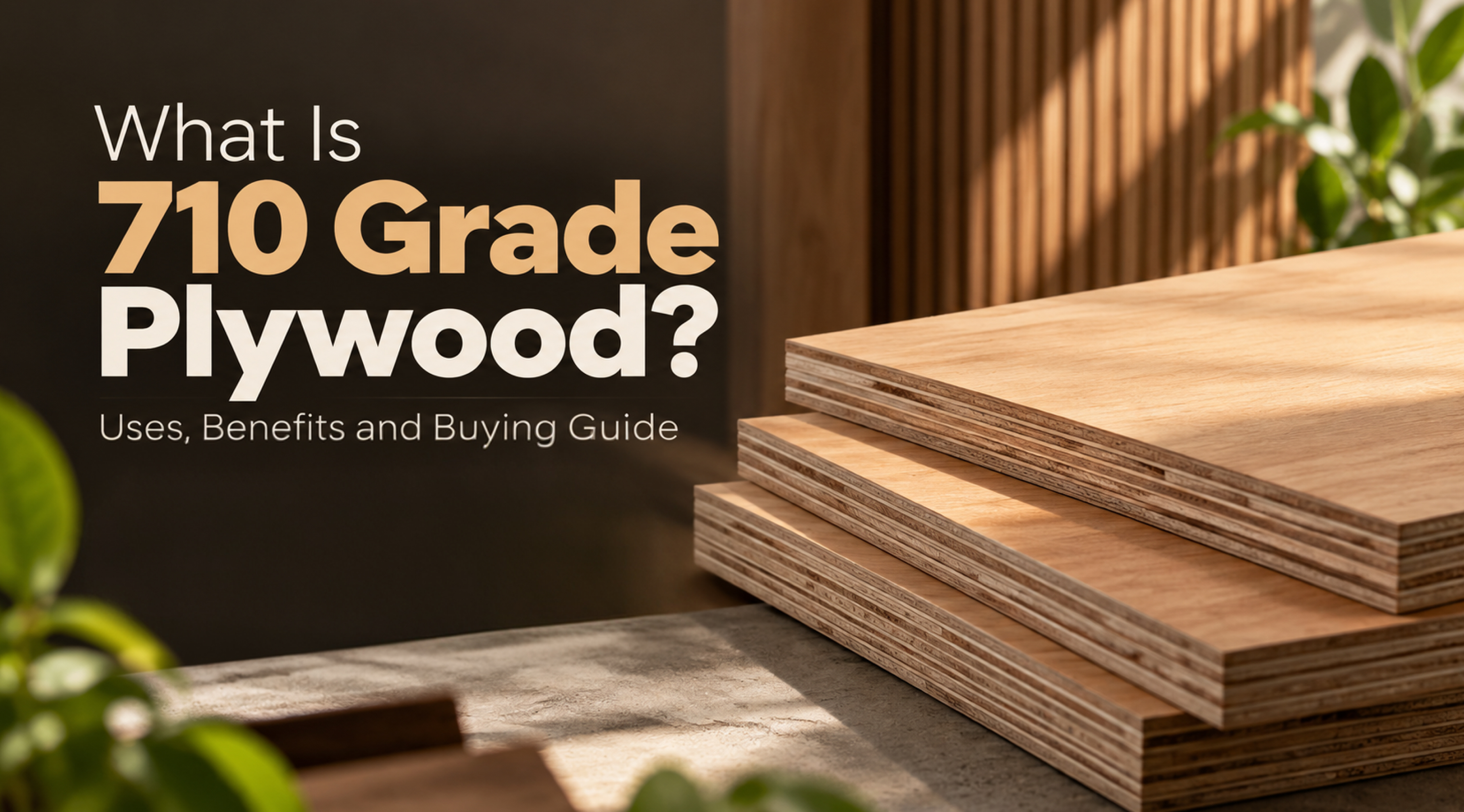
What Is 710 Grade Plywood
Choosing plywood sounds simple until you start comparing grades.
You may hear terms such as MR, BWR, BWP, 303 and 710 from a dealer, contractor or carpenter. The problem is that these numbers and abbreviations do not mean much if you do not know what they actually represent.
So, what is 710 Grade Plywood?
In simple terms, 710 Grade Plywood is plywood manufactured according to the IS:710 standard and is commonly known as BWP (Boiling Waterproof) or marine-grade plywood. It is designed for applications where plywood may face significant moisture, water or demanding environmental conditions.
That makes it particularly relevant for areas such as kitchens, bathrooms, utility spaces and certain exterior applications.
But there is more to 710 plywood than simply calling it "waterproof." Let's understand what the grade means, where it should be used and what you should check before buying it.
What Does 710 Grade Plywood Mean?
The "710" in 710 plywood refers to IS:710, the Indian Standard specification associated with marine plywood.
Unlike ordinary interior plywood intended mainly for relatively dry conditions, IS:710 plywood is designed for much more demanding moisture exposure.
It is generally classified as BWP, or Boiling Water Proof, plywood. Competitor guides and plywood manufacturers commonly describe IS:710 as marine-grade plywood because of its ability to withstand prolonged exposure to moisture and water better than conventional MR or BWR options.
This makes the grade particularly useful when the plywood itself is going to be part of an environment where water cannot realistically be avoided.
Think about the cabinet under a kitchen sink.
Even if the plumbing is perfect, small leaks, spills, cleaning water and humidity can eventually reach the cabinet. Choosing plywood designed for higher moisture exposure gives the furniture a better chance of maintaining its structural integrity over time.
How Is 710 Plywood Different From Regular Plywood?
The biggest difference is the level of moisture resistance required from the board.
A plywood sheet used inside a dry bedroom wardrobe does not face the same conditions as plywood used inside a kitchen cabinet below a sink.
That is why choosing plywood purely on price can be a mistake.
For example, imagine spending ₹1 lakh or more on a modular kitchen and then selecting a lower-grade plywood simply to save money on the board.
If moisture eventually causes swelling, delamination or structural deterioration, replacing the affected cabinet can cost much more than the initial saving.
The purpose of 710 plywood is to provide a more suitable material for such demanding applications.
Why Is Phenol Formaldehyde Resin Used in 710 Plywood?
One of the important factors behind BWP plywood is the adhesive used to bond the veneer layers.
Phenol formaldehyde (PF) resin is commonly associated with IS:710/BWP plywood because it provides strong bonding and better resistance to moisture than adhesives intended for less demanding applications.
This matters because plywood is made by bonding multiple layers of wood veneer together.
If the adhesive bond cannot handle moisture, prolonged exposure can eventually lead to problems such as delamination.
With a suitable waterproof bonding system, the veneer layers can maintain their bond under much harsher conditions.
However, it is important to remember that the plywood grade is only one part of a finished furniture system. Proper edge sealing, installation, joints and protection from direct water leakage also matter.
Main Benefits of 710 Grade Plywood
1. High Resistance to Water and Moisture
The primary reason people choose 710 plywood is its performance in moisture-prone environments.
It is designed for BWP applications where conventional interior plywood may not be the right choice.
This is why 710 plywood is commonly recommended for kitchens, bathrooms and other areas exposed to substantial moisture.
2. Strong Bonding Between Veneers
The waterproof adhesive system helps maintain the bond between the individual veneer layers.
That is particularly important when the board is exposed to humidity or water over time.
3. Suitable for Demanding Applications
710 plywood is not limited to one type of furniture.
It can be considered for kitchen cabinets, bathroom furniture, utility storage, certain exterior applications and other projects where moisture resistance is a priority.
4. Better Choice for Water-Prone Areas
The right plywood depends on where it will be installed.
A living-room cabinet may not need the same moisture resistance as a kitchen sink cabinet.
Using a more suitable grade in the areas where water exposure is expected can help improve the durability of the finished furniture.
5. Long-Term Value
The cheapest plywood is not necessarily the most economical choice.
If a board fails prematurely because it was unsuitable for its environment, replacement and repair costs can quickly outweigh the original saving.
That is why it makes sense to look at the expected life and conditions of the project rather than only the price per sheet.
Where Is 710 Grade Plywood Used?
The best way to understand 710 plywood is through real applications.
Kitchen Cabinets
The kitchen is one of the most common places where high moisture resistance becomes important.
Consider the cabinet below a sink. It may encounter water from spills, cleaning, plumbing connections and condensation.
Using BWP/710 plywood in moisture-prone kitchen furniture can be a sensible choice.
Bathroom Cabinets and Vanities
Bathrooms regularly experience humidity, splashes and changes in moisture levels.
For vanity units and storage installed in such areas, 710 plywood can be considered when high moisture resistance is required.
Utility Areas
Washing-machine areas, utility cabinets and storage near water connections can also benefit from plywood designed for higher moisture exposure.
Exterior or Semi-Outdoor Applications
Certain outdoor or semi-outdoor applications require materials capable of handling changing weather and humidity.
The suitability still depends on the complete design and finishing system, but 710 marine-grade plywood is commonly positioned for demanding environmental conditions.
Marine Applications
The term "marine plywood" comes from its suitability for demanding applications historically associated with boats and marine environments.
Modern residential use, however, is much broader and commonly includes kitchens, bathrooms and other moisture-prone areas.
Is 710 Plywood Completely Waterproof?
This is an important distinction.
710 plywood is classified as Boiling Water Proof (BWP) and is designed to withstand severe moisture exposure. However, calling any finished furniture installation completely immune to water damage can be misleading.
The performance of a finished cabinet also depends on:
- Edge sealing
- Laminate or veneer finishing
- Joints
- Hardware installation
- Plumbing
- Exposure duration
- Quality of installation
For example, if a kitchen cabinet is made from excellent 710 plywood but a leaking pipe continuously releases water into an unsealed edge, the overall furniture can still suffer damage.
So, 710 plywood provides a strong moisture-resistant foundation; it does not replace proper construction and maintenance.
710 vs 303 Plywood: What's the Basic Difference?
This is one of the most common questions buyers ask.
In broad terms, IS:303 covers plywood for general purposes, including MR and BWR categories, while IS:710 is associated with BWP/marine-grade plywood intended for more demanding moisture conditions.
A simple way to think about it is:
303/MR: Suitable for relatively dry interior applications.
303/BWR: Better suited to areas with moderate moisture exposure.
710/BWP: Designed for applications where much higher moisture and water resistance is required.
The correct choice depends on the environment.
You do not necessarily need 710 plywood for every piece of furniture in your home. Using a premium moisture-resistant grade where there is little moisture exposure may unnecessarily increase the project cost.
But using a lower grade in a consistently damp or water-prone area can create problems later.
How to Choose Good 710 Grade Plywood
Before buying, do not simply ask the dealer for "710 plywood."
Check the actual product specifications.
Look for the IS:710 Standard
Make sure the product is genuinely manufactured to the claimed standard and carries the appropriate certification/marking.
Check the Manufacturer
Buy from a manufacturer with clear product information, testing details and warranty terms.
Check Thickness
710 plywood is available in different thicknesses. The appropriate thickness depends on the furniture design, span, load and application.
Do not assume that thicker always means better. The construction and intended use also matter.
Ask About Termite and Borer Protection
If the plywood is being used for expensive furniture, additional protection against biological deterioration can be valuable.
Check what protection the manufacturer actually provides rather than assuming every 710 product has identical treatment.
Review Warranty
A warranty can provide useful information about the manufacturer's confidence in the product.
For example, Bhutan Tuff 710 is marketed with a 15-year warranty along with features such as glue protection, self-balancing technology and termite/borer protection.
What Makes Bhutan Tuff 710 Different?
Bhutan Tuff 710 is manufactured using seasoned timber and is designed around moisture resistance and durability.
The product uses pre-pressing technology and glue protection, while the company's product information highlights Self Balancing Technology, dual-side calibration, sanding and termite/borer protection. It is available in multiple thicknesses, including 4mm, 6mm, 9mm, 12mm, 16mm and 19mm.
The product is positioned for applications ranging from furniture and doors to wall coverings and water-prone interiors.
For homeowners, the practical takeaway is simple: if you are selecting plywood for a kitchen, bathroom or another moisture-exposed project, ask your contractor not just for "waterproof plywood," but for the exact grade and product specifications.
Is 710 Plywood Worth the Extra Cost?
That depends on where you use it.
If you are building a bedroom shelf that will remain completely dry, paying a premium for maximum moisture resistance may not provide much practical benefit.
But consider a kitchen sink cabinet.
The cost of upgrading the plywood may be relatively small compared with the overall cost of the modular kitchen. In that situation, selecting a grade designed for higher moisture exposure can make more sense.
The goal is not to use the most expensive plywood everywhere.
The goal is to use the right plywood where the conditions demand it.
Frequently Asked Questions About 710 Grade Plywood
What is 710 Grade Plywood?
710 Grade Plywood is plywood manufactured according to the IS:710 standard and is commonly classified as BWP or marine-grade plywood. It is designed for applications requiring high resistance to water and moisture.
Is 710 plywood waterproof?
IS:710 plywood is BWP, or Boiling Water Proof, grade plywood and is designed for high moisture resistance. However, the finished furniture still needs proper sealing, installation and protection from continuous uncontrolled water exposure.
Is 710 plywood good for kitchens?
Yes. It is particularly suitable for moisture-prone kitchen applications such as cabinets around sinks and other areas where water exposure is possible.
Is 710 plywood suitable for bathrooms?
Yes. Its high moisture resistance makes it a suitable choice for many bathroom furniture and vanity applications.
What is another name for 710 plywood?
IS:710 plywood is commonly referred to as BWP plywood or marine-grade plywood.
Is 710 better than 303 plywood?
Neither grade is automatically better for every application. 710 is designed for higher moisture exposure, while IS:303 plywood covers general-purpose applications including MR and BWR categories. The right choice depends on where the plywood will be used.
How long does 710 plywood last?
Its service life depends on product quality, installation, environmental exposure and maintenance. Some manufacturers provide long warranties; for example, Bhutan Tuff states a 15-year warranty for its 710 plywood.
Final Thoughts
So, what is 710 Grade Plywood?
It is IS:710 plywood designed for BWP, or Boiling Water Proof, performance and commonly known as marine-grade plywood. Its main advantage is its suitability for demanding moisture and water-exposure conditions.
That makes it a strong option for applications such as kitchen cabinets, bathroom furniture, utility areas and other projects where ordinary interior plywood may not be the right choice.
But choosing plywood should never be based on the grade alone.
Consider the actual environment, moisture exposure, thickness, construction quality, installation method, manufacturer specifications and warranty.
For homeowners and contractors, the simplest rule is this:
Use the plywood grade according to the conditions it will face.
And when moisture is a major concern, Bhutan Tuff 710 provides a purpose-built option designed around durability, waterproof performance and long-term use.