





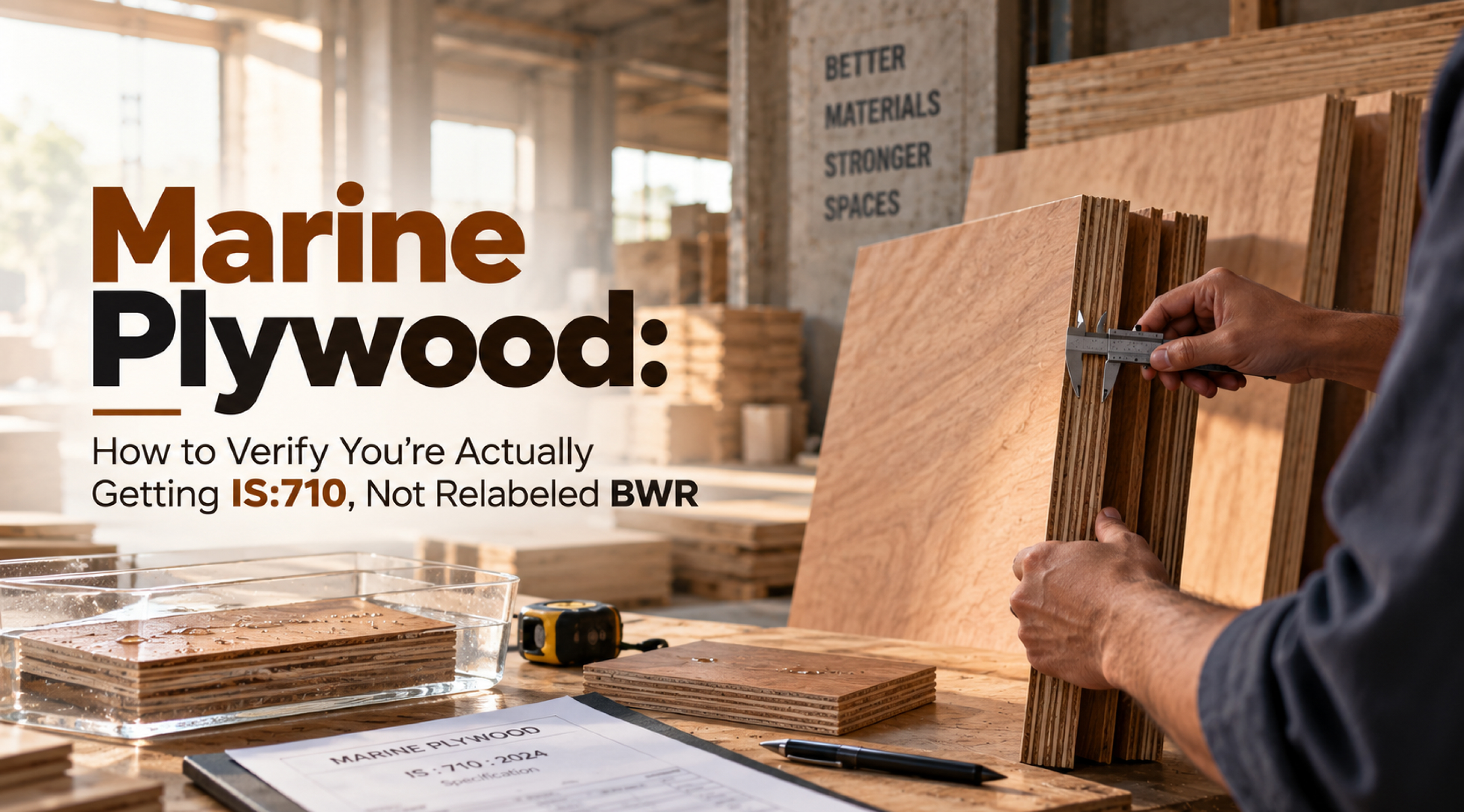
Marine Plywood: How to Verify You're Actually Getting IS:710, Not Relabeled BWR
Search marine plywood and you'll find dozens of articles explaining what it is boiling waterproof, IS:710 certified, made with phenol-formaldehyde resin, used in boats and wet areas. All accurate. What almost none of them tell you is that marine plywood is also one of the most commonly mislabeled products in the Indian plywood market sheets that are genuinely BWR grade, sold with a marine plywood sticker slapped on, at a price close to genuine IS:710 but without the actual certification behind it.
We're Bhutan Tuff, and since we manufacture genuine IS:710 marine plywood, here's how to actually verify what you're buying instead of taking the label at face value.
Why Mislabeling Happens So Easily With Marine Plywood
Genuine marine plywood and top-tier BWR plywood can look nearly identical to the eye similar colour, similar surface finish, similar weight in some cases. The real difference is inside: marine plywood uses phenol-formaldehyde (PF) resin throughout every layer and is built to pass a 72-hour boiling water test without delaminating, while BWR uses a different, less robust adhesive formulation that resists water but isn't built for that level of sustained submersion.
Because the visual difference is subtle and the performance difference only shows up after years of water exposure, it's genuinely easy for a seller knowingly or not to sell BWR plywood as marine grade, especially since the price gap gives room to still turn a profit while charging less than genuine IS:710 typically costs.
The BIS License Number Check Almost Nobody Actually Does
Every genuine IS:710-certified plywood sheet is required to carry a BIS (Bureau of Indian Standards) CM/L license number stamped on the sheet, along with the IS:710 mark itself. This isn't just a logo it's a specific, traceable license number tied to that manufacturer's BIS certification for marine-grade production.
Here's what almost no buyer actually does with that number: check it. The BIS maintains a searchable database of licensed manufacturers and their certified product standards. If a seller can't show you a CM/L number on the sheet, or the number doesn't correspond to a genuine IS:710 marine plywood license when checked, that's a direct signal you're not looking at certified marine grade regardless of what the seller calls it verbally or what's printed on a sticker.
The Boiling Water Demo You'll See at Some Dealers (And Why It's Not Proof)
Some dealers demonstrate water resistance by dipping a plywood sample in hot water for a few minutes to show it doesn't immediately delaminate. This is a reasonable sales demonstration, but it's not remotely the same test that IS:710 certification actually requires the genuine standard involves boiling in water for a sustained period (referenced at 72 hours in the standard's testing protocol) to confirm the adhesive bond holds under prolonged, not brief, exposure.
A BWR sheet can often survive a quick dip demonstration without visibly failing, which is exactly why this kind of demo doesn't tell you anything about whether a sheet would hold up to genuine long-term marine or heavy-moisture conditions. If a seller offers this demonstration as proof of marine grade, it's worth asking directly for the BIS certification number instead of relying on the visual test.
Price as a Sanity Check, Not Proof on Its Own
Genuine IS:710 marine plywood costs meaningfully more than BWR grade, because it uses more resin-intensive construction and higher-grade veneers throughout every layer, not just the outer faces. If you're being quoted a price close to standard BWR rates but told it's marine grade, that price gap alone is worth questioning genuine certification doesn't come at BWR pricing, because the raw material and process cost genuinely differ.
That said, a high price alone doesn't guarantee authenticity either some sellers charge marine-grade prices for BWR sheets specifically because buyers assume price is proof enough. Price is a useful first filter, but the BIS license number is the only thing that actually confirms what you're buying.
What to Actually Ask For Before You Buy
- The BIS CM/L license number stamped on the sheet — not just verbal assurance that it's "marine grade."
- Confirmation that the resin used is phenol-formaldehyde throughout the core, not just on the surface veneers.
- The manufacturer's name matching a licensed IS:710 producer, which you can cross-check against BIS's public database.
- A willingness from the seller to show certification documentation, not just a demonstration or a sticker on the sheet.
Where Genuine Marine Plywood Is Actually Worth the Cost
None of this is to say marine plywood is oversold for boat building, dock and jetty construction, or any application with sustained, direct water exposure, genuine IS:710 marine plywood is worth every rupee of the price gap over BWR, because it's built specifically to survive conditions BWR was never engineered for. The issue isn't the product; it's making sure the sheet you're actually buying matches the certification you're paying for.
Frequently Asked Questions
How can I tell if plywood is genuinely IS:710 marine grade? Check for a BIS CM/L license number stamped on the sheet, and verify that number against BIS's public licensee database. A sticker or seller's claim alone isn't sufficient proof.
Is a quick hot water dip test proof that plywood is marine grade? No. Genuine IS:710 certification involves sustained boiling water exposure over a much longer period than a brief demonstration dip, which even BWR-grade sheets can often survive without visible failure.
Why would BWR plywood be sold as marine plywood? The two can look visually similar, and mislabeling lets a seller charge closer to marine-grade pricing while using a less expensive adhesive system, which most buyers can't detect without checking the actual BIS certification.
Does marine plywood always cost significantly more than BWR? Genuine IS:710 marine plywood generally does cost more due to the resin and veneer quality required throughout the sheet, but price alone doesn't confirm authenticity — always verify the BIS license number directly.