




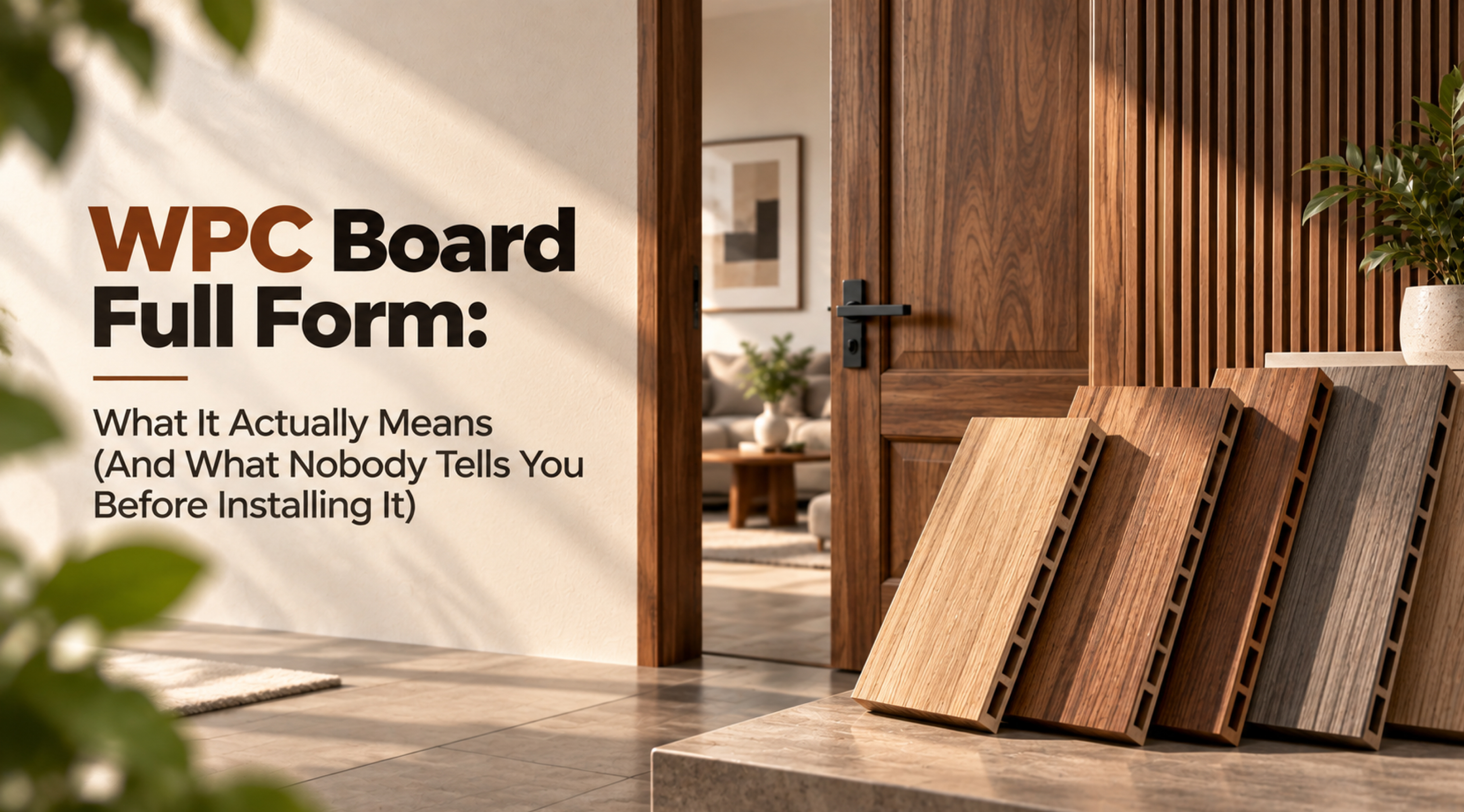
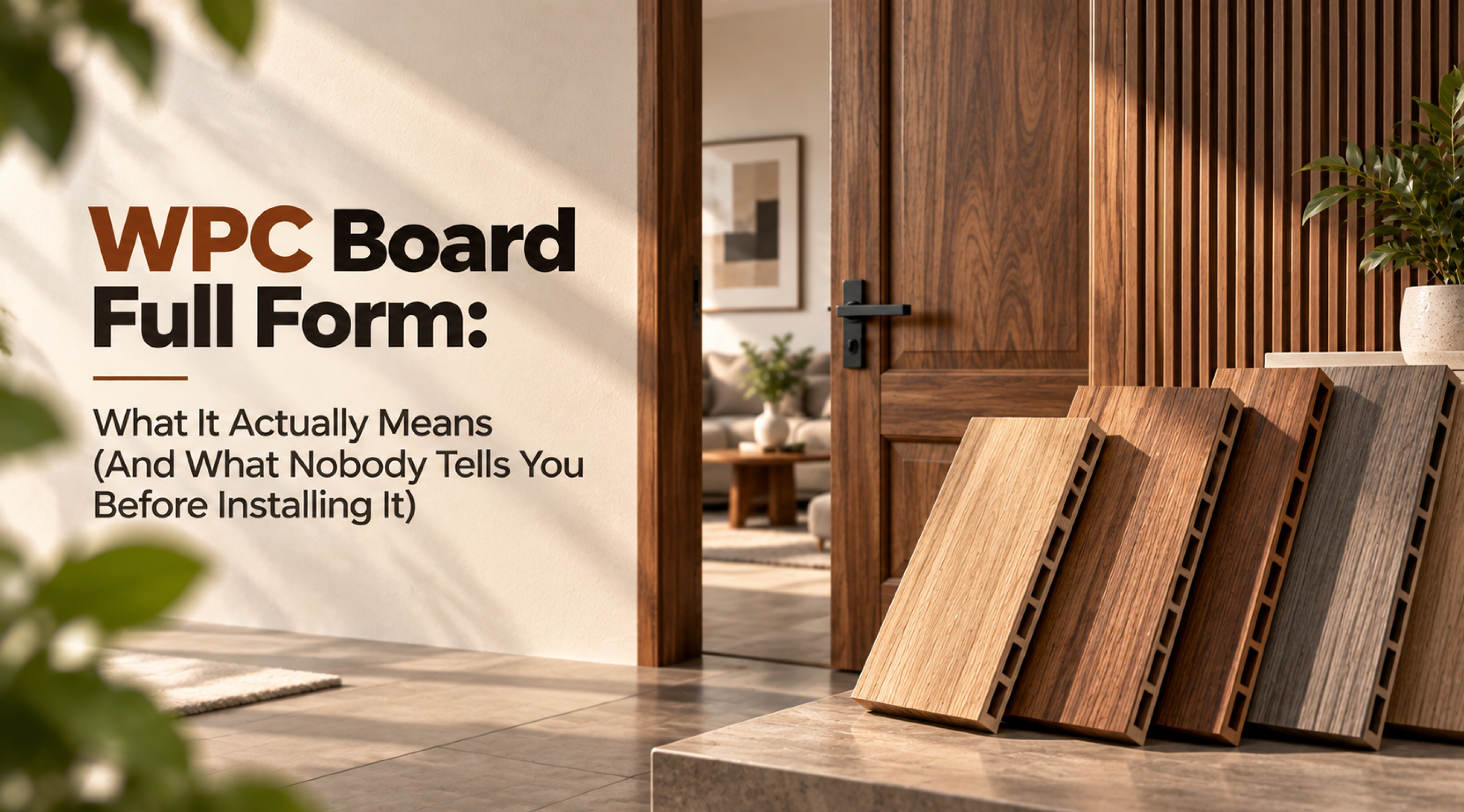
WPC board full form
Search WPC board full form and you'll get the same answer word for word on nearly every result: Wood Plastic Composite, roughly 70% virgin polymer, 15% wood powder, 15% additive chemical. That answer is accurate, and it's also about as far as most of this content goes nobody actually explains what that composition means once you're the one cutting, screwing, or gluing the board on-site.
We're Bhutan Tuff, and since we manufacture WPC boards ourselves, here's the full picture, not just the definition.
WPC Board Full Form: The Straightforward Answer
WPC stands for Wood Plastic Composite. It's an engineered board made by blending wood fibre or wood powder with thermoplastic polymer and a small proportion of additive chemicals, then processing the mixture into solid sheets. The result behaves more like plastic in some ways and more like wood in others which is exactly where the confusion, and the practical mistakes, tend to start.
The Confusion Almost Nobody Clears Up: WPC vs. PVC
Walk into most hardware markets and you'll find WPC board and PVC board sitting side by side, often looking nearly identical at a glance. They're not the same material. A PVC foam board is pure plastic with no wood content at all, while a genuine WPC board contains actual wood fibre blended into the polymer. This isn't a minor technicality it changes how the board behaves.
Because of the wood fibre content, WPC boards are generally denser, heavier, and more rigid than pure PVC foam boards of the same thickness. If you're comparing two boards that look alike but one feels noticeably lighter and flexes more when you press on it, that's usually the PVC one, not genuine WPC. If rigidity and load-bearing matter for your application door panels, structural cladding this distinction is worth checking directly with your supplier rather than assuming from the name alone.
Why Standard Wood Screws Don't Always Work
Here's a practical problem that catches a lot of first-time WPC installers off guard: a standard wood screw driven straight into a WPC board the way you would with solid timber often slips or fails to grip properly. This happens because WPC's composition with its high plastic content doesn't behave under a screw thread exactly like solid wood fibre does.
The fix is straightforward once you know it's needed: drill a pilot hole before driving the screw, and use coarse-thread screws designed for composite materials rather than standard fine-thread wood screws. Carpenters used to working exclusively with solid wood or plywood sometimes skip this step out of habit, and end up with a loose fitting that has nothing to do with the board's quality it's an installation technique mismatch, not a material defect.
Why Ordinary Wood Glue Doesn't Bond Properly
The same logic applies to adhesives. Standard PVA wood glue (the white glue most carpenters reach for by default) is formulated to bond with wood fibre, and it doesn't create a reliable bond on WPC's plastic-heavy surface. If a joint or panel edge is glued with ordinary PVA and it later comes apart, this is almost always the actual cause not a flaw in the board.
WPC-specific adhesives, or specialised bonding agents made for composite and plastic surfaces, are what actually hold on this material. If you're getting installation work done by a team unfamiliar with WPC specifically, it's worth confirming upfront what adhesive they're planning to use, rather than finding out after a joint fails.
Where WPC Genuinely Outperforms Plywood And Where It Doesn't
WPC's real strength is in exactly the applications where plywood struggles: constant moisture exposure, termite risk, and outdoor weather. Bathroom cabinets, window and door frames, wall cladding, and outdoor furniture are all places where WPC's water resistance and termite immunity give it a genuine, lasting edge over even high-grade moisture-resistant plywood.
Where it doesn't outperform plywood is raw load-bearing strength. WPC generally has lower tensile strength than BWR-grade plywood, and a WPC panel used as a long, unsupported shelf carrying heavy weight can sag over time in a way that a properly specified plywood shelf wouldn't. This isn't a flaw it's simply a different material with different strengths, and matching it to the right application (frames, panels, cladding) rather than every application is what determines whether it performs well for years or disappoints within one.
Frequently Asked Questions
What is the full form of WPC board?
WPC stands for Wood Plastic Composite an engineered board made from a blend of wood fibre, thermoplastic polymer, and additive chemicals.
Is WPC board the same as PVC board?
No. PVC board is pure plastic with no wood content, while WPC contains actual wood fibre blended into the polymer, making it generally denser and more rigid than PVC foam boards of the same thickness.
Why did my screws slip when installing a WPC board?
Standard fine-thread wood screws often don't grip WPC properly. Drilling a pilot hole first and using coarse-thread screws designed for composite materials usually solves this.
Can I use regular wood glue on WPC boards?
Ordinary PVA wood glue generally doesn't bond reliably to WPC's surface. A composite-specific adhesive is needed for a joint that actually holds over time.
Is WPC board stronger than plywood?
Not in terms of raw load-bearing strength BWR-grade plywood generally handles heavy weight better. WPC's advantage is moisture and termite resistance, making it the better choice for wet or humid applications rather than heavy structural load.